Join us to co-design community collaboration tools

We’re looking for people active in their community and people who support community activities and groups to help co-design tools which can support collaboration between groups, organisations and projects. See below or hop on over to the booking page for more details and to reserve places.

Co-designing community collaboration tools 1 Co-designing community collaboration tools 2

The New Reality – guidance for digital transformation in our sector

the-new-reality-highlights-from-the-study-3-1024

“The digital revolution has already happened, and we are living in the aftermath”

A really practical report and wonderful set of resources was published by Julie Dodd (@JulieDodd) a few months ago which I would highly recommend having a look at if you work or volunteer in our sector. It is all about how we can make our way along the journey to using digital technology to achieve the outcomes, impact and change which our organisations exist for. The resources have been created and drawn together following interviews with 50 senior leaders and digital experts from both inside and outside the non-profit sector. The New Reality site is a helpfully curated online resource comprising:

  • An overview and links to content about each of the 6 key themes:
    • leadership
    • culture
    • infrastructure
    • innovation
    • funding
    • service delivery
  • Some really lovely and useful resources, called take aways, which include the poster below, snappy slide sets and a video
  • The full report and an executive summary

The following are a few of the insights from the Executive Summary which really resonate with me:

  • Digital services will deliver greater value than anyone can imagine (but first we need to address the culture and infrastructure issues that are standing in the way)
  • Until sector leadership stops delegating responsibility for digital we’re not going to get very far
  • You don’t need a digital strategy. “Having a digital strategy will soon seem as ridiculous as having an electricity strategy”
  • A tried and tested process for delivering transformation already exists – it’s just not being used
  • The next stage of digital for non-profits is not fundraising and marketing
  • We need to think beyond web to a broad range of digital technologies to achieve maximum impact

I’ve been meaning to write here about The New Reality resources for some time (thank you to Paul Webster for bringing this to our attention), and I started working on this post while at Local Gov Camp in Leeds. Local Gov Camp is an unconference bringing together people who care about public services, which has a strong focus on digital / tech. I was fascinated to discover that people who work in local government seem to have many of the same concerns and challenges as people in organisations in our sector, though our starting positions are different. Perhaps there is potential for developing some solutions together.

Below is one of the take aways from The New Reality: 20 ways to achieve digital transformation in our sector (also available in pdf). I’d love to hear what you think about The New Reality research, the resources and what support you would like from Dudley CVS in relation to digital transformation. Leave a comment here or get in touch with us on twitter (@dudleycvs) or Facebook.

poster from The New Reality

Be the hedgehog!

photo of a hedgehog on grassWhat have hedgehogs got to do with radical innovation?

Well, as suggested in a Disrupt & Innovate blog post“hedgehogs symbolise radical innovation because as curling up into a ball – their very successful defence strategy for millions of years – became ineffective when the car was invented, hedgehogs changed their strategy and learned how to run.”

The Disrupt & Innovate project ran a campaign this summer to find civil society hedgehogs. Using a twitter hashtag #BeTheHedgehog, they sought examples of “people, teams or whole organisations that are courageously innovative reacting to changes in the world by changing themselves and the way they pursue their mission…  so that all of us can learn from them and from each other and get better at what we do.”

We are now looking for hedgehogs in Dudley borough, to help us design a programme of support for people in our sector who are keen to lead innovation and transformation* in their teams, organisations or communities. If you are a hedgehog, or know one, please leave a comment below or get in touch with me (lorna@dudleycvs.org.uk / 07501 722255 / twitter @dosticen) so that we can involve you in a conversation later this month.

* What do we mean by innovation and transformation? – you may well ask, as these are buzzwords which have lost their impact through over-use.

Innovation

Innovation can be defined as the act or process of introducing new ideas, methods or devices. In our sector we tend to focus on what is often called social innovation. This is about finding novel solutions to social problems that are more effective, efficient, sustainable, or just, than present solutions. Social innovations create value primarily to society as a whole rather than private individuals.

Social innovations can be described as new strategies, concepts, ideas and organisations that meet social needs – they extend and strengthen civil society. Social innovation includes the social processes of innovation, such as open source methods and techniques and also the innovations which have a social purpose.  (From wikipedia)

Transformation

This could mean changes in how an organisation is structured, how it operates, and/or how it is financed – often in response to changes in the context in which it is working. Examples of transformation we could develop knowledge around and try out include:

Obviously we don’t want organisations to innovate and transform for the sake of it. We are here to connect and inspire people and organisations to achieve positive change so that we have caring, vibrant and strong communities across the borough. So part of our focus is on supporting organisations to be resilient and sustainable. As well as financial sustainability, we are keen to support organisations to be adaptable and develop their leadership and strategic muscles. 

If you’d like to help us design ways that we can provide support around all of these sorts of things please get in touch. We’ll be thinking and talking about ideas this month and getting ready to start doing things next month.


Image credit: Soerfm, shared through wikimedia commons using a creative commons licence

A different starting point

One of the best things I do in my job at the moment is work with residents in Coseley who are leading the Big Local programme, along with my colleagues Neil and Donna. We’ve recently been testing out new ways to support people with ideas who want to start activities. We have worked hard with residents to develop a process which embraces the underpinning ethos of East Coseley Big Local: to start with what is already available around us.

Doris and Vusa live in Coseley and want to start a weekly out-of-school education, recreation and mentoring programme for 8 – 14 year olds. They agreed to help test our new process. A month ago they joined Dudley CVS staff and four residents from the East Coseley Big Local Core Group. We started off by sharing some examples of inspiring projects from other places around the world. Doris was interested in Singledingen, a project started by neighbours in a park in Rotterdam, and Hackney Pirates, an amazing out-of-school learning adventure started by a teacher and local people.

Then we introduced our Ideas Canvas, which prompted conversation about what Doris, Vusa and other members of their team bring in terms of passion, skills, experience and knowledge. Together we identified who they might like to meet to help them get started. Something we asked which was a bit of a surprise to Doris and Vusa was: ‘What could the children bring and contribute to the programme?’ They hadn’t thought about this before, but readily considered ways that children could share their talents with each other, and be supported to take on leadership roles.

Another surprise was that we were able to help Doris and Vusa to cut their costs for 2 taster sessions by about two-thirds, by re-thinking some activities with them, and by sourcing materials and equipment that could be borrowed from local groups. This was possible due to members of local groups being involved in the Big Local Core Group, added to by the local knowledge of Dudley CVS officer Neil Langford. An unexpected outcome of bringing people together in the way we did was that after also hearing about a children’s holiday club which was planned at Darkhouse Baptist Church, Doris volunteered to help out with it. And in turn she had offers of help for her taster weekend.

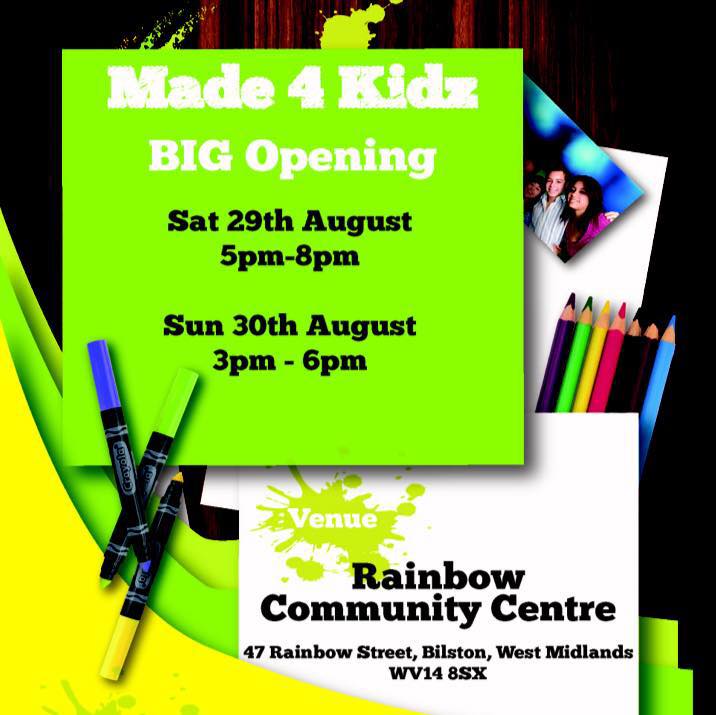
Made 4 Kidz, founded by Doris and Vusa, now has a lovely bright website, a Facebook Page and two taster sessions running this weekend at the Rainbow Community Centre. Leaflets have been delivered to households in the area. Please do help spread the word.

Also do let us know what you think about connecting people and resources in neighbourhoods, and any experiences you have of doing it.

Made 4 Kidz Big Opening flyer

A fireside chat and five priorities

Photo of Joel Gascoigne and Nick Holzherr in front of screen with glowing fireplace

Photo from the fireside chat shared by Laura Creaven on twitter

On Tuesday I went along to a Fireside Chat* with Joel Gascoigne, co-founder and CEO at Buffer. Buffer is a really handy software application which you can use for free to schedule posts to social media accounts in Twitter, Facebook, LinkedIn and more.  Joel studied in the West Midlands at the University of Warwick, and Buffer was developed and launched in 2010 while he lived in Digbeth, Birmingham. The co-founders moved to Silicon Valley in 2011 and have always been the subject of much interest and attention because of their radically open and transparent business practices.

Buffer made the salary calculations and salaries of each team member public and openly publish revenues from their paid for products. They are fully transparent with email (all team members can see all emails) and they have introduced transparent pricing so you see where every penny (or cent) goes if you subscribe to a paid plan. In Buffer one of their values is default to transparency.

I thoroughly enjoyed hearing Joel share his story and respond to questions which were submitted through twitter. And it got me thinking about what we’re sharing about Dudley CVS. Then I realised we haven’t really talked much about some priorities we’ve developed this year, and now is a great time to share them here because we have just started getting together as staff and board members to take each of them forward.

Our priorities have been shaped in response to what we heard from our sector in a survey we carried out late last year (Kate shared the findings in this post) and also give focus to key areas of activity we have been developing. Here is a run down of our 5 priorities.

Championing Dudley CVS and the sector 

Our survey told us that the top request in relation to support we should offer over the next year was raising the profile of the voluntary and community sector. A group of Dudley CVS staff and trustees met last week to begin collective work around this priority, so you’ll soon be seeing a growing offer to groups and organisations around this. Do get in touch with Becky (smallgroups@dudleycvs.org.uk) if you have skills or ideas to contribute to our work around this.

Enabling and promoting innovation, transformation and sustainability

Our survey also highlighted that people want support in relation to:

  • identifying gaps in local provision, working with new and existing groups to address unmet needs in communities
  • developing groups and organisations
  • ways to diversity income streams
  • innovation and transformation
  • advocacy and leadership of the voluntary and community sector

While we offer support around these areas already, we think there will be some value in us offering a programme of support which people can access in different ways. A group of Dudley CVS staff and trustees met last week and discussed some initial ideas, the next step is to involve people from local groups and organisations in shaping the programme. If you’d like to make suggestions please add a comment to this post, if would like to join an informal ideas session in September please let me know (lorna@dudleycvs.org.uk).

Supporting and enabling collaboration in Dudley borough

Ranked fourth in the list of support people want us to offer is supporting and enabling networking and collaboration. And ranked third is creating the conditions for our sector to influence. A group of our staff and trustees will be reviewing pervious and current work around this and shaping what we can do in the next 12 months. I have already been sharing some examples of activity over the last few years and thinking on collaborative practices on the CoLab Dudley blog. We’ll keep you updated on the work of the group looking at this priority, our first meeting will be next month.

Collaborating and demonstrating impact (using PSIAMS)

Dudley CVS and a number of voluntary organisations in the borough are changing their approach to working with people, and using a tool called PSIAMS to help them manage relationships, communicate and collaborate within and across teams, and to measure the impact and value of their work. We already have a great team supporting the use of the approach and software (Mark Ellerby from Cloudberry, plus Dudley CVS officers James Baggot and Adam Deyes). There will also be a trustee and staff group working on ways that our sector can collaborate and demonstrate impact.

Ensuring use of our venues benefits local communities 

Over the last few years Dudley Council has been working with Dudley CVS to explore ways to make the most of the council’s underused buildings and land in a challenging climate and safeguard them (or even unlock them) for community use. Asset transfer was a option for one building we looked at, a management move was an option in another. The council is continuing to develop and test new processes which involve community-based organisations taking on facilities. The initial steps with us should help to set the tone and ease this transition for other facilities and organisations.

Dudley CVS are now managing Brierley Hill Civic, and we have staff and a Lunch on the Run cafe moving in to a building on Stafford Street in Dudley Town Centre (the name of the building will be revealed shortly). It is really important to us that we both show that we can make a financial success of such ventures, and that we can do that in ways which support, connect and benefit local communities, groups, clubs and societies, as well as our sector more widely. We have a group of trustees and staff with a diversity of skills and connections who will give time to making ensuring we achieve this.

Do leave a comment or get in touch if you have any thoughts on any of our priorities, and please do share links to information about what your group or organisation is currently focusing on. We’d love to hear about it!


For anyone interested in the Buffer event, I’ve archived some useful links, tweets and pictures from the Fireside Chat here.

*Fireside Chats were a series of radio addresses given by President Franklin Roosevelt and the contemporary spin on this at the event I went to was a backdrop of a 3 hour You Tube fireplace video screened for the entire duration of the talk. It was nearly as mesmerising as a real fire!

From Dudley to Dublin

Last month officers from Dudley Council met with people from local voluntary organisations and community groups. The aim of the session was to begin shaping a plan for joint delivery of the Community Council vision, building on work the council have been doing to date. Council officers shared the poster below (available here as a pdf) which articulates the council’s vision. Discussion focused on opportunities which could be included in a plan for the next year.
Community Council Poster

Following the planning activity, we were invited to share thoughts and ideas on steps to achieve the changes listed on the right hand side of the poster:

  • The council changing how they do things: designing and delivering services with people, reducing red tape, having honest conversations
  • The council knowing local communities: understanding community strengths as well as needs, and making decisions by listening and talking to people
  • The council changing their culture: recognising that communities can lead, being open, honest and approachable, and supporting their staff to embrace change
  • The council working differently in communities: starting with what’s good in communities, enabling communities to make things happen, facilitate rather than control.

We will, of course, share notes and the plan developed from the session on this blog. We’ll also be looking for ideas, inspiration and learning from other places. Such as Dublin.

Two years ago Dublin City Council launched DCC Beta projects, described by Innovation Dublin as:

… a new approach by Dublin City Council to experiment, innovate and quickly test ideas directly ‘on the street’… and to solicit the opinion of Dubliners who walk, cycle or drive around these streets everyday.

The Council is suggesting it as a new way of trialling ideas, away from the realities or pressures of a ‘real’ project. The trials could last days, weeks or months, but generally wouldn’t be longer than a year or so.

While Dublin City Council ‘trials’ ideas all the time, it’s generally as part of a real project (for example the LED lights in Smithfield).  The difference between a ‘trial’ and a ‘beta’ is what the Council call ‘the headache-factor’. If something has to be changed in a beta project it generally wouldn’t (read shouldn’t) cause a problem, whereas in a trial it probably would.

Dublin City Council describe what being in ‘beta’ means on the DCC Beta blog:

Dublin City and Dublin City Council needs to be able to easily and regularly freely discuss ideas and to innovate – and to innovate you need to be able to experiment and to then learn from those experiments, and which in turn enables greater discussion.

We’re calling this overall ethos or approach ‘Dublin City Council beta’.

“Beta” and “in beta” are labels used (mainly by the IT sector) to convey that something’s imperfect and is being released early so that it can benefit from some real-world testing and feedback. We adopted this phrase as it enables us to build ‘a brand’ (ie a recognisable ethos) with an associated and established method, whereas a generic phrase such as “trial” might mean different things to different people.

There is more on the DCC beta blog about how the initiative works, and you can find out more about the beta projects on the really lovely twitter feed (@DCCbeta) or Facebook Page: DCCBetaProjects.

What do you think about Dublin’s initiative? What are your thoughts on Dudley’s Community Council vision? Leave us a comment here, on our Facebook Page or on twitter.

Nehemiah UCHA – Helping people to live independently and stay out of hospital

nehemiah

Nehemiah UCHA is a progressive housing association serving the African Caribbean, Asian, Irish and European communities. The Association provides homes for single people, families, couples and elderly people in Birmingham, Coventry, Dudley, Sandwell, Walsall and Wolverhampton. Henry Court based in Dudley provides 38 permanent one and two bed apartments. All have level access showers which are great for people who have recently been discharged from hospital or have mobility problems. Henry Court specialises in meeting the multi-cultural needs of its residents and provides a good choice of African Caribbean food. Lots of fun social activities are offered to residents and the wider community to reduce loneliness and improve wellbeing. Some of these activities include:

Continue reading

2014/15 a year of change and challenge

Following four very successful years (funding wise) 2014/15 proved to be a year where funding successes were much reduced however other opportunities came to the fore.

In the 4 years previous over 100 successful funding applications generated above £5M in new money into Dudley to support the great work of the voluntary, community and faith sector. However in 2014/15 there were just 13 successful applications resulting in new funding for organisations in Dudley totalling just over £700,000.

2 Big Lottery successes for Dudley Advocacy (£296,892) and Summit House Support (£288,287) were the grant funding highlights of the year. Lynda Nock from Dudley Advocacy said:

Martin was always ready to answer questions as soon as he could and his response whether by phone or email was prompt and efficient. I knew straight away that I could rely on him and his knowledge

A friendly, approachable method of working and always professional, in meetings and over the phone and email

Nothing changed in my usual approach to supporting the sector; I worked with 30 organisations, having over 60 meetings during which funding opportunities were identified and applications discussed.

What did change though was being involved in different approaches to securing support for organisations in our sector and to help them in becoming safer financially and more sustainable. During the year I attended various workshops/training courses around Social Finance and European funding.

As a result a series of articles on Social Finance have appeared in the Echo newsletter during 2015. The Building Better Opportunities funding initiative financed through the Big Lottery and EU funding has been launched in the Black Country and we are very much involved in Dudley.

Alongside all this activity I am continually discussing with organisations other ways of being more effective and efficient in these days of funding cuts and austerity. Suggestions include expanding services and bringing in a charging structure where appropriate (trading) as well as working more collaboratively and sometimes in partnership to achieve economies of scale, reducing costs etc.

Whilst the aim of this short blog is to show our involvement and successes at the front line of funding it is also here to reassure the sector that we are very much at the forefront of change and always keen and willing to support organisations as we move forward in these often challenging and exciting times that we currently live in. Lynda sums this up well by saying:

With the impact of statutory funding cuts within the voluntary sector, I believe that the funding information/advice/support that DCVS offers is vital for voluntary organisation to obtain funding in the future


How far we’ve come with Brierley Hill Civic Hall

Col Civic

Since taking on Brierley Hill Civic we’ve found that everyone from local small groups to international music promoters are very excited in the work we’re doing to bring new life into this amazing building.

We took on on the Civic in February and we’ve had great support from the council, staff at the Civic, businesses and charities, all helping us in the early stages of this exciting journey. In March we kicked off with an open day to learn more about what the community, organisations, schools and businesses want from their Civic Hall.

Continue reading

Building groups, building friendships: Black Country Integration Project

bcip
On Friday evening I had the pleasure of visiting the Mayor of Dudley’ parlour to celebrate the launch of one of my groups, Black Country Integration Project.

Continue reading